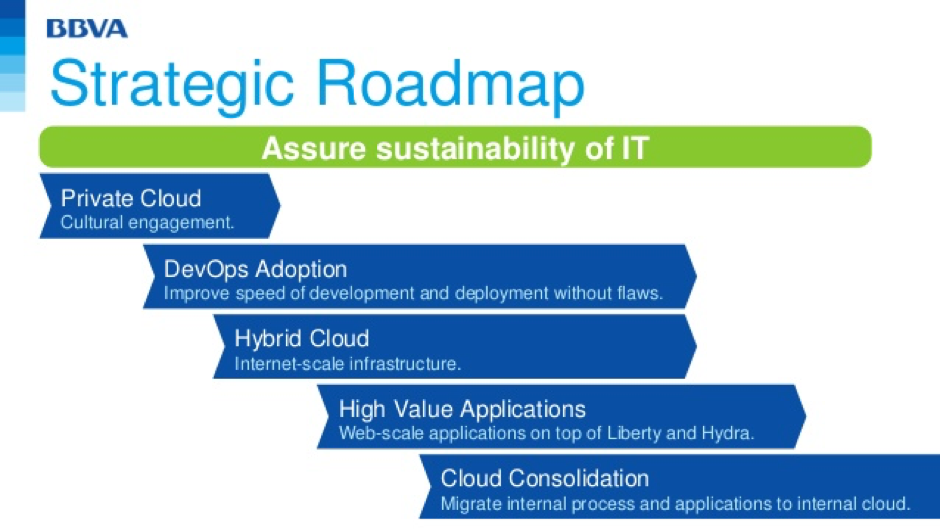
For some years, the huge advantages of the public cloud made it the best option for any company, mainly due to the important matter of storage cost. But, actually, over time it has been different. Most companies, especially in complex sectors like the banking industry, have strengthened their position in the hybrid cloud. They have also shifted toward Service as a Platform (PaaS) models, also private, even if they keep part of their services in public PaaS.
When a company looks at whether to go for a public, private or hybrid PaaS model, some points taken into special consideration include:
● The data. A large volume of data creates opportunities, and also some problems. The public cloud brings down storage costs greatly, but also has its drawbacks when the level of storage required for the information is excessively large. Moving this huge volume of data from proprietary systems over to public ones is not an easy task. Also, often the platforms or applications developed by a bank or a company depend on external systems that cannot be moved over to the public cloud or integrating them proves to be highly complex.
● Performance. I/O performance is a key factor taken into account in an IT team’s decisions. Any PaaS strategy depends on the performance of services provided to third parties.
● Security. Some market providers, especially those who specialize in providing private PaaS services, believe that the public cloud cannot guarantee minimum security requirements for banking. Other alternatives that some banks have opted for are open-source solutions with dependency insurance polices against the provider.
OpenStack, the alternative for several banks
OpenStack is a cloud computing project to provide Infrastructure as a Service (PaaS), which underlies the Platform as a Service model (PaaS). It is an open-source solution, which is distributed under an Apache license. OpenStack has been managed since 2012 by the OpenStack Foundation, an organization with 30,000 members in 170 countries.
Leading companies from the financial sector, such as Wells Fargo, Bank of America, American Express and BBVA, have opted for its services. The most recent bank to take a similar decision was Barclays. In mid-2015 it choose OpenStack to manage its private cloud with an initial integration that affected more than 100,000 servers, with hundreds of service applications for its customers.
OpenStack offers banks two advantages to compete in the world of banking: the flexibility, speed and scalability of open-source solutions; and the security and privacy required in the financial sector provided by a private cloud computing solution. The BBVA IT team’s technology roadmap followed these five steps:
Bank of America is another bank to choose OpenStack to migrate part of its internal infrastructure and with proprietary providers to this open-source solution. Although the company encountered some problems in 2015 with the migration of 6,500 SDDC technology workloads from one infrastructure to the other, it seems that those incidents were eventually solved.
The initial plan of the company’s CTO, David Reilly, was to move 1,500 workloads a month over to OpenStack, out of a total of 70,000 in a company with more than $21 billion in assets. In 2016, the plan includes migration of workloads from IT systems and also from CRM (customer relation management).
The case of JP Morgan Chase and Apprenda
Any change at JP Morgan Chase can be a real headache. With financial assets valued at $25 billion, this investment bank is one of the biggest in the world. Indeed, in 2010 it was noticed that its IT infrastructure was causing operating and performance problems for the company and, consequently, for millions of customers. It was then that they decided to migrate applications, servers and the work of hundreds of developers to a private PaaS solution provided by Apprenda.
● Excessively long delivery times because the deployment of applications, due to the company’s infrastructure and software compilation and verification system, was very slow. No flexibility.
● Inability to manage scalability needs.
● Costs due to underutilization of the physical and virtual infrastructure.
● Poor management of DevOps teams, obliged to repeat processes.
The change brought about some competitive advantages for JP Morgan Chase:
● 70% increase in use of infrastructure.
● 700% growth in productivity of development teams.
● Delivery times improved by 50 days.
● The private PaaS with Apprenda hosts more than 2,000 applications with no increase in storage and resource management costs.
Banco Bilbao Vizcaya Argentaria, S.A. owner of this portal uses cookies and/or similar technologies of its own and third parties for the purposes of personalization, analytics, behavioral advertising or advertising related to your preferences based on a profile prepared from your browsing habits (e.g. pages visited). If you wish to obtain more detailed information, consult our Cookies Policy.
Cookie settings panel
These are the advanced settings for first-party and third-party cookies. Here you can change the parameters that will affect your browsing experience on this website.
Technical Cookies (required)
These cookies are used to give you secure access to areas with personal information and to identify you when you log in.
Name
Owner
Duration
Description
gobp.lang
BBVA
1 month
Language preference
aceptarCookies
BBVA
1 year
Configuration Accepted Cookies
_abck
BBVA
1 year
Helps protect against malicious website attacks
bm_sz
BBVA
4 hours
Helps protect against malicious website attacks
ADRUM_BTs
Salesforce Marketing Cloud
Session
Required for monitoring of the service, inherent to SFMC
ADRUM_BT1
Salesforce Marketing Cloud
Session
Required for monitoring of the service, inherent to SFMC
ADRUM_BTa
Salesforce Marketing Cloud
Session
Required for monitoring of the service, inherent to SFMC
ADRUM_BT
Salesforce Marketing Cloud
Session
Required for monitoring of the service, inherent to SFMC
xt_0d95e
Salesforce Marketing Cloud
Session
Remember user preferences (if any)
__s9744cdb192d044faa1bf201d29fafd1e
Salesforce Marketing Cloud
Session
Remember user preferences (if any)
wpml_browser_redirect_test
WPML
Session
Text translation in the portal
wp-wpml_current_language
WPML
24 hours
Text translation in the portal
Analytics Cookies
They are used to track the activity or number of visits anonymously. Thanks to them we can constantly improve your browsing experience
Your browsing experience is constantly improving.
With your selection, we cannot offer you a continuously improved browsing experience.
Name
Owner
Duration
Description
AMCV_***
Adobe Analytics
Session
Unique Visitor IDs used in Cloud Marketing solutions
AMCVS_***
Adobe Analytics
2 years
Unique Visitor IDs used in Cloud Marketing solutions
demdex (safari)
Adobe Analytics
180 days
Create and store unique and persistent identifiers
sessionID
Adobe Analytics
Session
Launch's internal cookie used to identify the user
gpv_URL
Adobe Analytics
Session
Adobe Analytics plugin: getPreviousValue Capture the value of a certain variable in the following page view, in this case the prop1
gpv_level1
Adobe Analytics
Session
Cookie used to store the DataLayer levl1 of the previous page.
gpv_pageIntent
Adobe Analytics
Session
Cookie used to store the pageIntent of the previous page.
gpv_pageName
Adobe Analytics
Session
Cookie used to store the pagename of the previous page.
aocs
Adobe Analytics
Session
Cookie that stores the first values collected at the beginning of a process.
TTC
Adobe Analytics
Session
Cookie used to store the time between the App Page Visit event and the App Completed event.
TTCL
Adobe Analytics
Session
Cookie used to store the time between the LogIn event and App Completed.
s_cc
Adobe Analytics
Session
Determine if cookies are active
s_hc
Adobe Analytics
Session
Cookie used by Adobe for analytical purposes
s_ht
Adobe Analytics
Session
Cookie used by Adobe for analytical purposes
s_nr
Adobe Analytics
2 years
Determine the number of user visits
s_ppv
Adobe Analytics
Permanent
Adobe Analytics plugin: getPercentPageViewed Determine what percentage of the page a user views
s_sq
Adobe Analytics
Session
ClickMap/ActivityMap features
s_tp
Adobe Analytics
Session
Cookie used by Adobe for analytical purposes
s_visit
Adobe Analytics
2 years
Cookie used by Adobe to know when a session has been started.
Advertising Cookies
They allow the advertising shown to you to be customized and relevant to you. Thanks to these cookies, you will not see ads that you are not interested in.
The advertising is customized to you and your preferences.
Your choice means you will not see customized ads, only generic ones.
Name
Owner
Duration
Description
OT2
VersaTag
90 days
VersaTag Cookie used to store a user id and the number of user visits.
u2
VersaTag
90 days
VersaTag Cookie where the user ID is stored
TargetingInfo 2
MediaMind
1 year
Cookie that serves to assign a unique random number that generates MediaMind.
Customization Cookies
These cookies are related to general features such as the browser you use.
Your experience and content have been customized.
With your selection, we cannot offer you a continuously improved browsing experience.
Name
Owner
Duration
Description
mbox
Adobe Target
9 days
Cookie used by Adobe Target to test user experience customization.
Looks like you’re browsing from MexicoSpainArgentinaPeruColombiaBelgiumChileUSAFranceHong KongItalyPortugalUnited KingdomTurkeyUruguayVenezuelaAlemania, so let’s show you the custom content for your
location. Change
Select a country
In order to access the private area and corresponding sandbox, select the country of the APIs you want to use.